

New to thinking of agents as users? Start treating AI agents like first-class users explains how agents behave in products and how fast their traffic is growing.
Why measure agents in Mixpanel
Most teams start from one of two places. You filter automated traffic. Depending on how you filter, an agent buying for a customer can be removed along with a crawler indexing your catalog. When that happens, you can’t see how much of your product agents use, or where they get stuck. You’ve never looked. Agent activity is mixed into your numbers. A conversion rate or a funnel drop-off may be partly an agent’s doing, and you can’t tell. Either way, agents aren’t being measured on their own terms, and measures built for people don’t always translate. Mixpanel classifies events as agent, bot, or neither, so you can analyze agents with the reports you already use.Tell agents from bots
Mixpanel classifies events by Actor Type. Exclude the bots, keep the agents.
Define success for agents
Track completion rate, steps to success, and time to convert instead of time on site.
Use the reports you have
Break down any report by Actor Type. Compare funnels, event mix, and conversion for agents and people side by side.
This guide covers agents that show up to use your product. If you’ve built an agent into your product and want to measure how it’s doing, start with Agent Intelligence.
Three habits for measuring agents
These three habits take you from raw traffic to a clear picture of what agents do in your product, so you can fix what’s getting in their way.Tell agents apart from bots
You may see automated traffic described as traditional bots, AI crawlers, and AI agents. Mixpanel sorts it into two classifications, bot and agent. Mixpanel’s ingestion APIs classify the user agent of each event and set the following default event properties:$mp_actor_type(Actor Type):agentfor requests from an LLM acting on behalf of a human user (e.g. ChatGPT or Claude Code),botfor generic automated traffic such as crawlers and search indexers, andnonewhen neither applies.$mp_actor_name(Actor Name): the classified identity behind anagentorbotactor type, such asGPTBot,ClaudeBot, orMistralAI-User. Only present when the actor type isagentorbot.$mp_raw_user_agent(Raw User Agent): the raw user agent associated with the request.
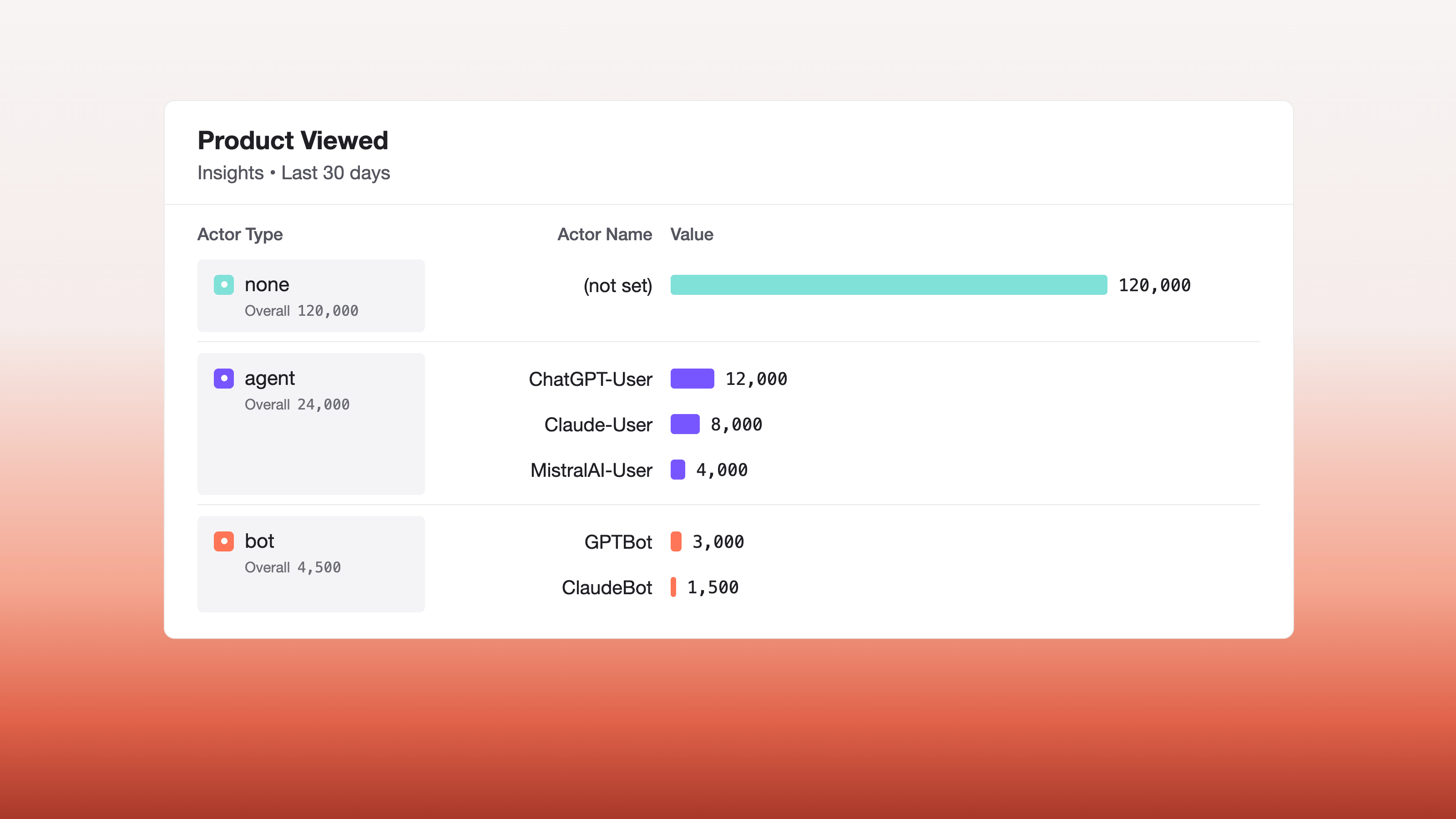
bot. Events tracked before classification was available have no Actor Type and appear as (not set), so excluding bot (rather than filtering on none) keeps them in your reports. If you already filter automated traffic another way, check whether it removes agents too.
If you don’t send the end user’s user agent as $mp_raw_user_agent or $mp_user_agent, classification uses the user agent of the request that reached Mixpanel. With server-side tracking, that is your server’s HTTP library, so classification can be inaccurate. If you track server-side, forward your end user’s raw user agent as $mp_raw_user_agent or $mp_user_agent. See Tracking Browser, Device, and OS.
If you want to block bots at ingestion, review how Mixpanel handles unwanted traffic.
Define success for an agent
Time on site means different things for people and for agents. A long visit can mean interest from a person and trouble for an agent. An agent is after one thing, the information or action it was sent for, so it rewards pages that make that easy to find. That means a measure that signals success for people can signal a problem for agents. Pick the event that marks success for the task, like Order Completed or Account Created, and use the same event for people and agents. Then track three things for agents:- Completion rate. What share of agents reach the event.
- Steps to success. How many events it takes to get there.
- Time to convert. How long it takes. Shorter usually means the agent found what it needed.
Compare agents and people side by side
Build a funnel from first touch to your success event, then break it down by Actor Type. Look at four things: where each group drops off, how long conversion takes, how much activity each group generates, and which events agents fire that people rarely do, or the other way around. The last one shows you which parts of your product agents lean on most.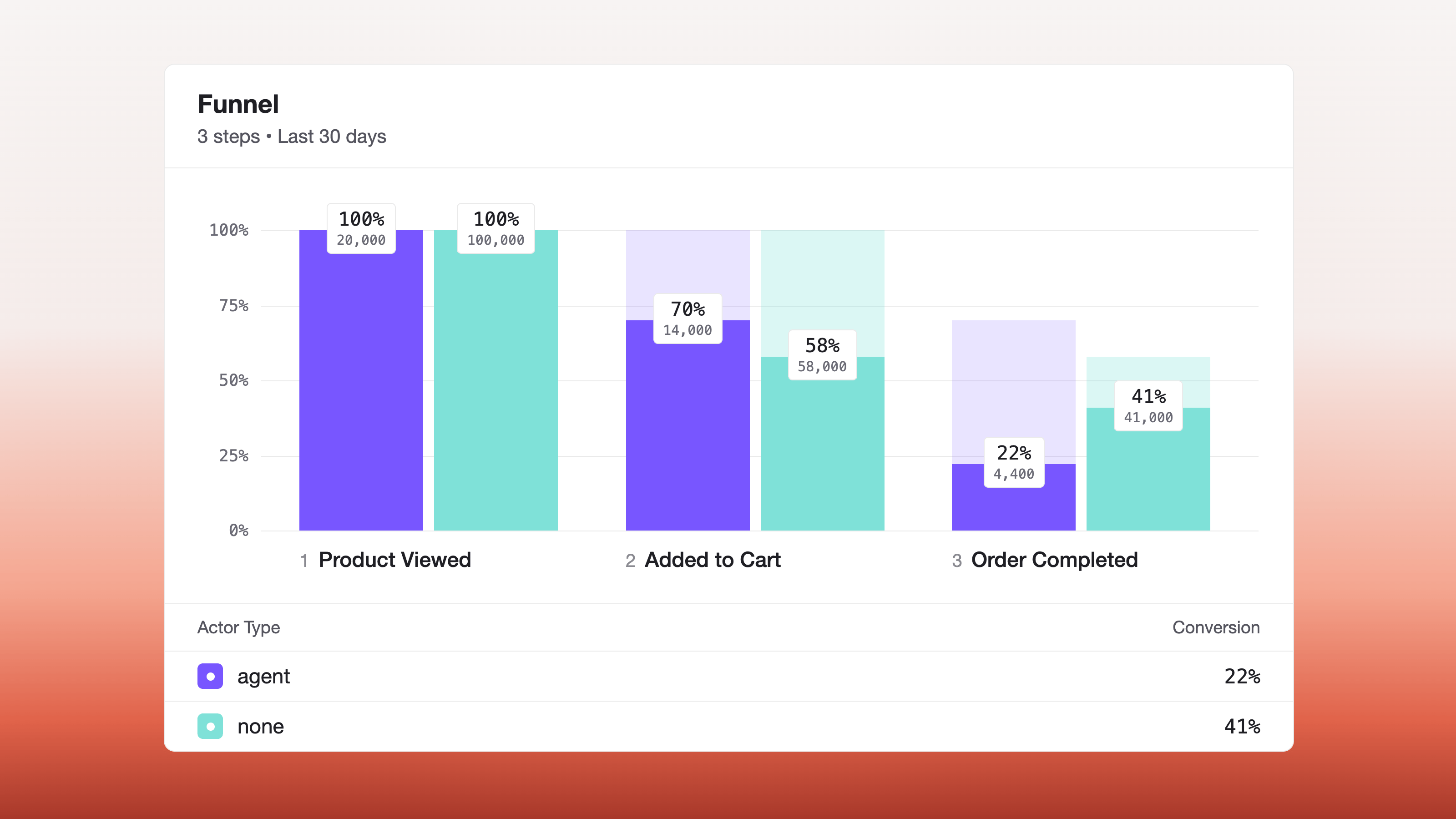
Try it: Compare how agents and people check out
Here’s how the habits come together on a common question for an ecommerce product: Do agents finish checkout as often as people, and where do they stop?
Build the funnel and break it down by Actor Type. Then compare conversion at each step and time to convert. You can also ask Mixpanel Agent: “Show me the funnel from Product Viewed to Order Completed for people and agents.” Review what it builds before you rely on it.
When the comparison comes in, it could lead to learnings such as:
- Agents drop at the same step as people. The friction isn’t specific to agents. Fix it once and both groups benefit.
- Agents drop at a step people clear easily. Break that step down by Actor Name and by properties like page or error message. The page may rely on visuals, or an error may not explain what to do next.
- Agents convert as often as people, but faster or slower. Check whether the gap makes sense for the task before treating it as good or bad.
- Agents convert more often than people. That’s a good sign for how your product works for agents. Check that your success event means the same thing for both groups before you celebrate.
Make the call on what you find, and keep watching
Agent traffic is changing quickly, so a baseline you set now is worth more than a perfect analysis later.- Save the funnel to a Board. Keep it next to the reports your team already checks, so agent behavior doesn’t live in one person’s tab.
- Take drop-offs to the team that owns the page. A drop-off at one step is a specific, fixable request for whoever owns that step.
- Rerun the funnel after every release. If agents and people need different measures, you can’t tell whether a release was worth it until you can see them separately.
Next step
Break down your top funnel by Actor Type
Pick the funnel closest to revenue and add Actor Type as a breakdown. It takes seconds, and you’ll see how much of that funnel agents already use.