

Overview
Mixpanel data is stored and isolated within a project. At this time, you cannot query data across multiple projects. Mixpanel supports a few different categories of data that can be used for analysis: events, user profiles, group profiles, and lookup tables. In data warehouse parlance, events make up the fact table while user profiles, group profiles, and lookup tables are dimension tables.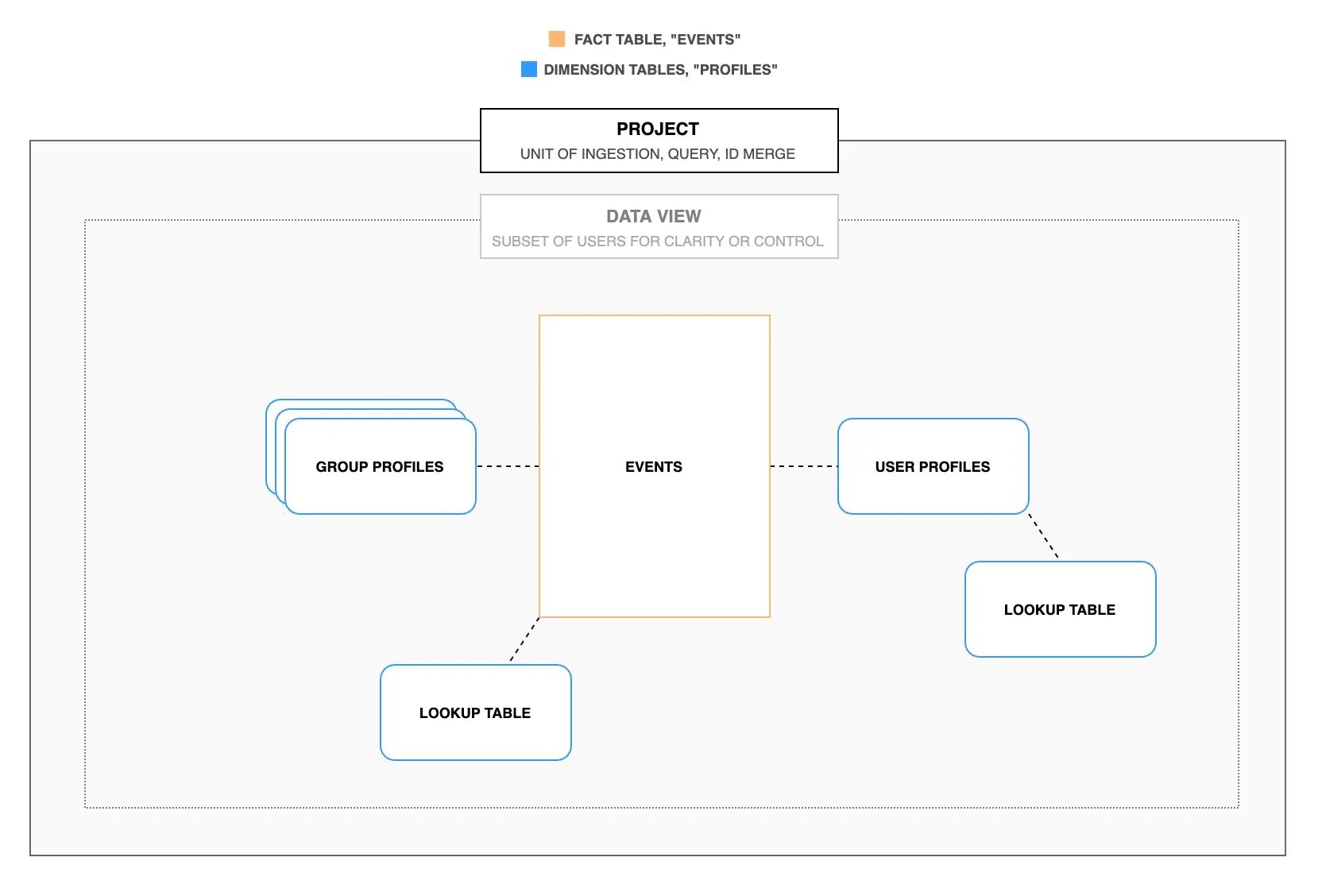
Event Property vs User Profile Property
An event property is a detail about an event. Event properties are incredibly important, as they provide the necessary context about events to ensure valuable analytics. Properties also facilitate the dissection of data, allowing for more detailed insight into event-driven data. Once tracked, events and their properties are immutable, meaning they cannot be changed. Profile Properties give you detail about a certain user overall. In other words, Profile Properties describe your users as they exist in this moment. A user profile property could be a static value, such as a first name, or be something more likely to change, like the date of last login or the number of songs a user has played. For example, while an Event Property or Super Property tells you whether a user had a paid or free account over time when a user did specific actions, a Profile Property would simply show you currently if they are paid or free.Example
Imagine you work on a music streaming product and you want to answer questions like:- What are the most popular songs and artists this week?
- What is the distribution of number of songs played per week by user?
- Which experiment performed better in an A/B test to drive a higher conversion rate from Free to Premium accounts?
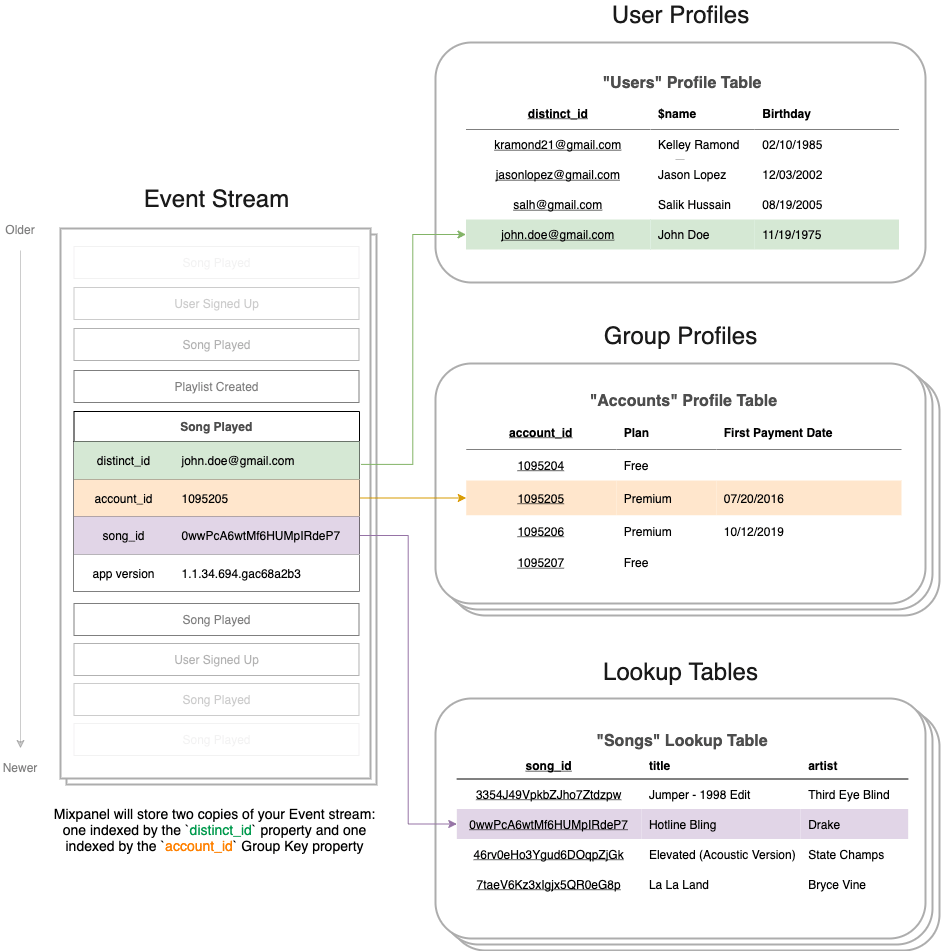
account_id. You also want to augment your events with details about songs being played so you create a “Songs” lookup table and specify the join key as song_id. Your data model will look like this:
Anatomy of an Event
The following event represents the fact that userjohn.doe@gmail.com played the song_id of 0wwPcA6wtMf6HUMpIRdeP7 on Tuesday, September 29, at 2020 8:42:11 PM GMT on a machine with IP 203.0.113.9.
User Profiles, Group Profiles & Lookup Tables
All three are key/value stores that augment your event data with additional metadata about entities. The differences are whether the join key is customizable and whether events are copied and indexed by the join key. User profiles are joined to events viadistinct_id which is the default indexing for Events.
Group profiles are joined to events via an event property you specify as a group key. Once you create a new group key, we will add an additional index for your events on that property. This allows you to do funnels or retention by that property instead of by distinct_id.
Lookup tables are joined to events and user profiles using the join key that you specify. Unlike group profiles, your events are not indexed by the join key. You can use lookup table properties to do filtering, breakdowns, etc but you can’t do things like funnels analysis using the join key for uniques. Note: Currently, group profile properties cannot be lookup table keys.